
How to Travel the Globe Without Selling Your Textbooks
The Real Cost of Student Travel (And How to Actually Afford It)
Affordable student travel is more within reach than most students think — even on a tight budget.
Here’s a quick snapshot of what it actually costs and how to make it happen:
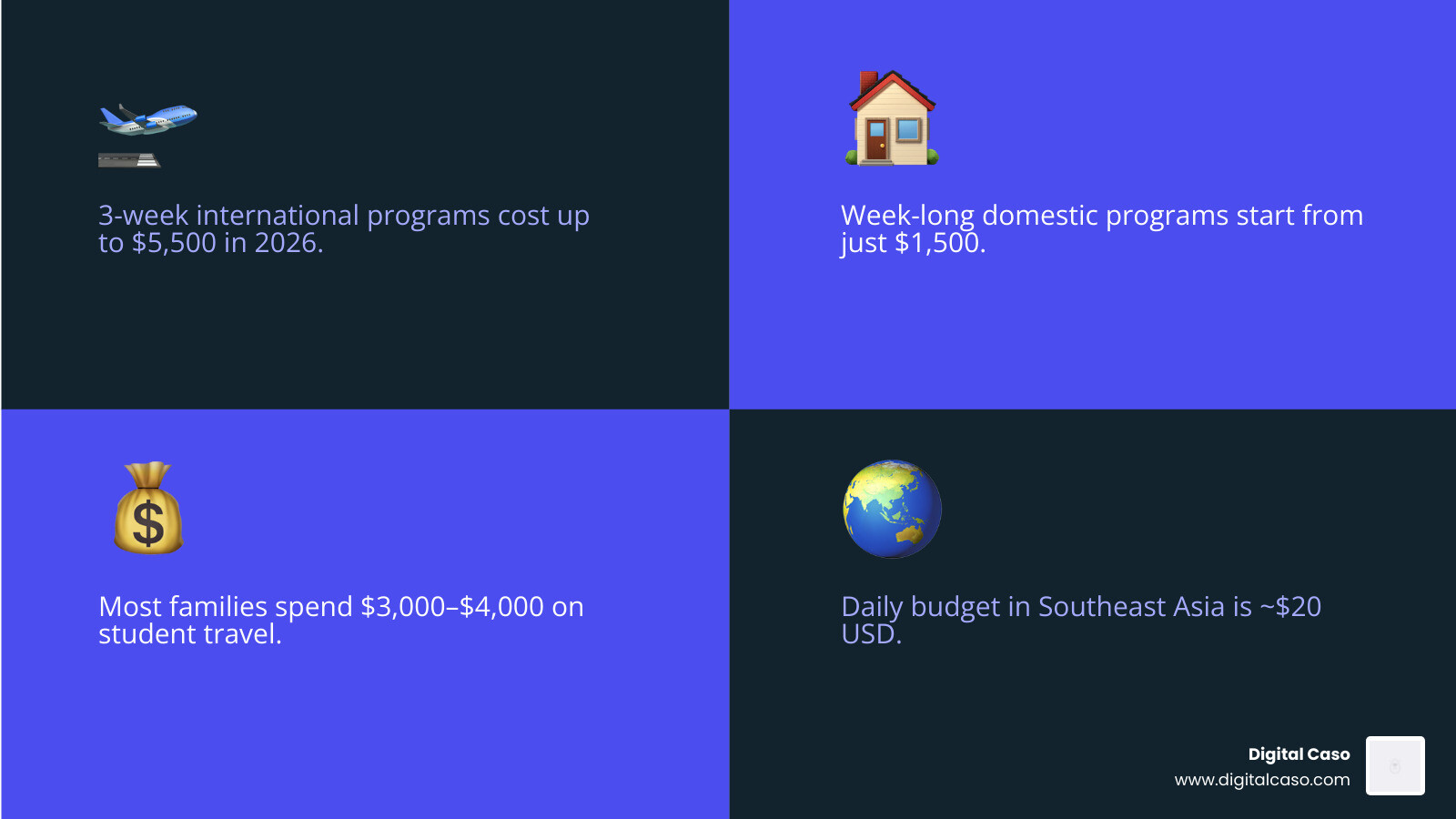
| Category | Typical Range (2026) |
|---|---|
| Week-long domestic program | from $1,500 |
| 3-week international program | up to $5,500 |
| Most families spend | $3,000–$4,000 |
| Daily spending money | $20–$40/day |
| Daily budget in Southeast Asia | ~$20 USD |
| Down payment to book a group trip | as low as $99 |
| Savings on student hotel/hostel rates | up to 40% off |
| Funds raised by students via community | $1,000–$3,000 |
The good news? You don’t need to sell your textbooks — or take out a second loan — to see the world.
Millions of students travel internationally every year on lean budgets. They use student flight deals, youth rail passes, volunteer programs, and smart payment plans to make it work. One student raised $2,300 through community fundraising to join a conservation project abroad. Another booked a full group trip for just $99 down.
The barriers are real — flights, program fees, accommodation, and daily expenses add up fast. But every one of those costs has a workaround, and this guide walks you through all of them.
Whether you’re a high schooler eyeing a summer service trip or a college student dreaming of a semester abroad, there’s a path that fits your budget.
The Core Benefits of Budget Exploration
When we talk about affordable student travel, we aren’t just talking about a vacation. We’re talking about a massive investment in your future. Traveling while you’re young isn’t just about the “likes” on your social feed; it’s about building a toolkit of life skills that you simply can’t get in a lecture hall.
Students who step outside their comfort zones often see a massive boost in self-confidence. Whether you are navigating the subway in Tokyo or coordinating a community project in Ghana, you are learning how to solve problems in real-time. These experiences build bilingual abilities and sharpen your teamwork skills—qualities that look incredible on a resume. Employers in 2026 are looking for “global citizens” who understand different cultures and can adapt to new environments.
Furthermore, international travel provides a unique platform for global networking. You’ll meet peers from across the world, forming bonds that can lead to professional opportunities down the road. However, we know that safety is the first thing on your parents’ minds. It is vital to follow Safety tips for students abroad to ensure your journey is as secure as it is transformative. Most reputable programs include 24/7 support and risk-management oversight to keep you safe while you explore.
Choosing affordable student travel Programs
Finding the right program is like picking the right major—it has to fit your goals and your wallet. In 2026, the variety of structured programs is wider than ever:
- Volunteer Projects: These are often the most budget-friendly. Some programs start as low as $100–$200 per week. You could be working on turtle conservation in Mexico, assisting in orphanage construction in Nepal, or participating in HIV/AIDS awareness initiatives in Ghana.
- Study Abroad: This isn’t just for a full year anymore. Short-term summer or winter sessions allow you to earn credits in places like Austria or Vietnam without the price tag of a full semester.
- STEM Tours: For the science-minded, these trips focus on hands-on learning, from robotics in South Korea to marine biology in the Galápagos.
- Language Immersion: Want to actually speak Spanish or Japanese? Immersing yourself in a local community is the fastest (and often most affordable) way to become fluent.
- Cultural Exchange: These programs focus on “living like a local.” You might stay with a host family, which significantly cuts down on accommodation costs while providing a deep dive into the culture.
Financial Strategies: Funding Your Journey
Let’s talk numbers. We know the “sticker price” of travel can be intimidating. In April 2026, a typical family might invest between $3,000 and $4,000 for a comprehensive summer program. But that’s rarely what the student pays out of pocket.
| Program Type | Duration | Estimated Cost (2026) | What’s Included |
|---|---|---|---|
| Domestic Service | 7–10 Days | $1,500 – $2,000 | Meals, Housing, Supervision |
| International Service | 14 Days | $2,000 – $3,500 | Meals, Housing, Local Transport |
| Adventure/Culture | 21 Days | $3,500 – $5,500 | All activities, most meals, 24/7 staff |
Note: International airfare is typically extra. Expect to budget $20–$40 per day for personal spending money (souvenirs, extra snacks, etc.).
The key is to look at the “Total Cost of Ownership.” A program that seems expensive might include all meals and transport, whereas a “cheap” program might leave you stranded with high daily costs.
Funding Your affordable student travel
You don’t need a massive savings account to get started. We recommend a “layered” approach to funding:
- Scholarships and Grants: This is free money. Many organizations give out over $100,000 annually in student travel scholarships. Check with your school’s financial aid office; you might be surprised to find you can use Pell Grants for international study if the program is credit-bearing.
- Fundraising: This is where your community comes in. Many students successfully raise $1,000–$3,000 through personal outreach. Create a unique, no-fee donation page and share it with family and friends. It’s much more meaningful than a birthday gift!
- Payment Plans: Don’t pay all at once. Many providers allow you to book with as little as $99 down and spread the remaining balance over 18 months or even two years. Some plans offer monthly installments as low as $80–$150.
- Community Support: Host a local event, like a car wash or a bake sale, or offer services like tutoring to build your travel fund.
Booking Hacks for Flights and Accommodation

Once you’ve picked a program or decided to go solo, it’s time to tackle the biggest expense: the flight. As an expert in affordable student travel, we can tell you that the “standard” price you see on search engines is rarely the lowest price available to you.
Student-specific booking platforms negotiate directly with over 220 airlines to offer exclusive discounts for those under 26 or 30. These aren’t just small discounts; users have reported paying half-price for international flights. Always look for “Youth Fares” or “Student Fares” which often come with added perks like lower change fees—perfect for when you decide you’re not quite ready to come home yet.
Saving on Ground Transportation and Stays
Once your feet are on the ground, the savings shouldn’t stop. Here is how we keep the daily budget low:
- Youth Rail Passes: If you are traveling through Europe, a discounted Youth Pass is essential. Available for those aged 12 to 27, these passes offer unlimited travel across 33 countries. Plus, if you’re traveling with younger siblings, children under 11 often travel for free.
- The 40% Rule: By using student-verified platforms, you can often save up to 40% off hotels and hostels. Hostels are the “gold standard” for affordable student travel—not just for the price, but for the community of like-minded travelers you’ll meet in the common room.
- Public Transport vs. Rideshares: In cities like London or Paris, the tube or metro is your best friend. In Southeast Asia, local buses and trains can cost less than the price of a coffee.
- Budget Airlines: Within regions like Europe or Asia, carriers offer flights for as low as $20 between major cities. Just watch out for those luggage fees!
Top Global Destinations for affordable student travel

Where you go determines how long your money lasts. In 2026, the world is more accessible than ever, but some regions offer significantly more “bang for your buck.”
Southeast Asia remains the undisputed champion of budget travel. In countries like Vietnam or Laos, it is entirely possible to find a clean bed and a delicious meal for less than $20 a day combined. These regions offer a mix of high-energy cities and serene natural landscapes that are perfect for a student budget.
Latin America is another high-value region, especially for students in North America who want to keep flight costs down. Mexico and Guatemala offer incredible cultural immersion and history for a fraction of the cost of a European trip.
High-Value Regions for 2026
If you’re planning your 2026 itinerary, we suggest putting these destinations at the top of your list:
- Vietnam: Incredible street food and low-cost hostels make this a backpacker’s dream. Daily budget: ~$20.
- Thailand: Great for both adventure (think jungle trekking) and relaxation. Top-value service programs here often run around $2,200 for two weeks.
- Mexico: Beyond the resorts, places like Oaxaca or the beaches of Baja California offer deep cultural roots and affordable living.
- Albania: Europe’s best-kept secret. It offers stunning Mediterranean coastlines at a fraction of the price of Greece or Italy.
- Poland: A hub for history and student life. Cities like Poznań and Kraków are incredibly affordable for dining and nightlife.
- Portugal: One of the most budget-friendly countries in Western Europe. You can enjoy world-class surfing and seafood without the “Parisian” price tag.
Safety and Support for Young Travelers
We get it—traveling can be scary, especially for first-timers. But “affordable” doesn’t mean “dangerous.” Reputable student travel organizations prioritize safety above all else. When we evaluate programs, we look for:
- Trained Supervision: Look for programs with 24/7 trained staff who are experts in the local area.
- Risk Management: This includes everything from checking the safety of local transport to having emergency response plans in place.
- Global Support: A 24/7 emergency hotline is a must-have. If something goes wrong, you need to know exactly who to call.
- Supervision Standards: For younger teens, look for clear ratios (like 1 staff member for every 8 students) and defined behavioral expectations.
- Travel Insurance: Never leave home without it. Many student programs include basic insurance, but it’s always worth checking if you need additional coverage for medical emergencies or trip cancellations.
Frequently Asked Questions about Student Travel
What is the average cost of a teen travel program in 2026?
In 2026, most families invest between $3,000 and $4,000 for a summer program. Week-long domestic trips can start around $1,500, while three-week international experiences that include service and adventure can reach $5,500. Many students offset this by raising $1,000–$3,000 through community support.
Can I use my existing financial aid for study abroad?
Yes! In many cases, federal and institutional aid (like Pell Grants) can be applied to study abroad programs if your home university approves the credits. Always speak with your financial aid office early in the planning process to see how your package can travel with you.
How do I find the cheapest flights for students?
The best way is to use platforms that require student verification. These sites negotiate exclusive “under 30” rates with over 220 airlines. Also, try to be flexible with your dates and use promo codes—stacking a student discount with a seasonal promo code is the ultimate pro move.
Conclusion
At Digital Caso, we believe that travel is the most essential part of a modern education. Our mission is simple: we want you to explore more, spend less, and learn everywhere. You don’t need a massive inheritance to see the Taj Mahal or hike the Andes; you just need a plan, a bit of hustle, and the right resources.
Whether you are looking for the perfect 14-day itinerary through Portugal or tips on the best hostels in Hanoi, we are here to help. Traveling young changes your perspective, builds your resume, and creates memories that last far longer than any textbook.
Ready to start your journey? Explore more with Digital Caso and discover how we can help you navigate affordable student travel. The world is waiting—go find your place in it!
